
Single-use
Content becomes unavailable after being viewed.
Use cases
A password, message, or sensitive document isn't always meant to remain accessible. A single-use link makes it possible to limit access to what is truly necessary.
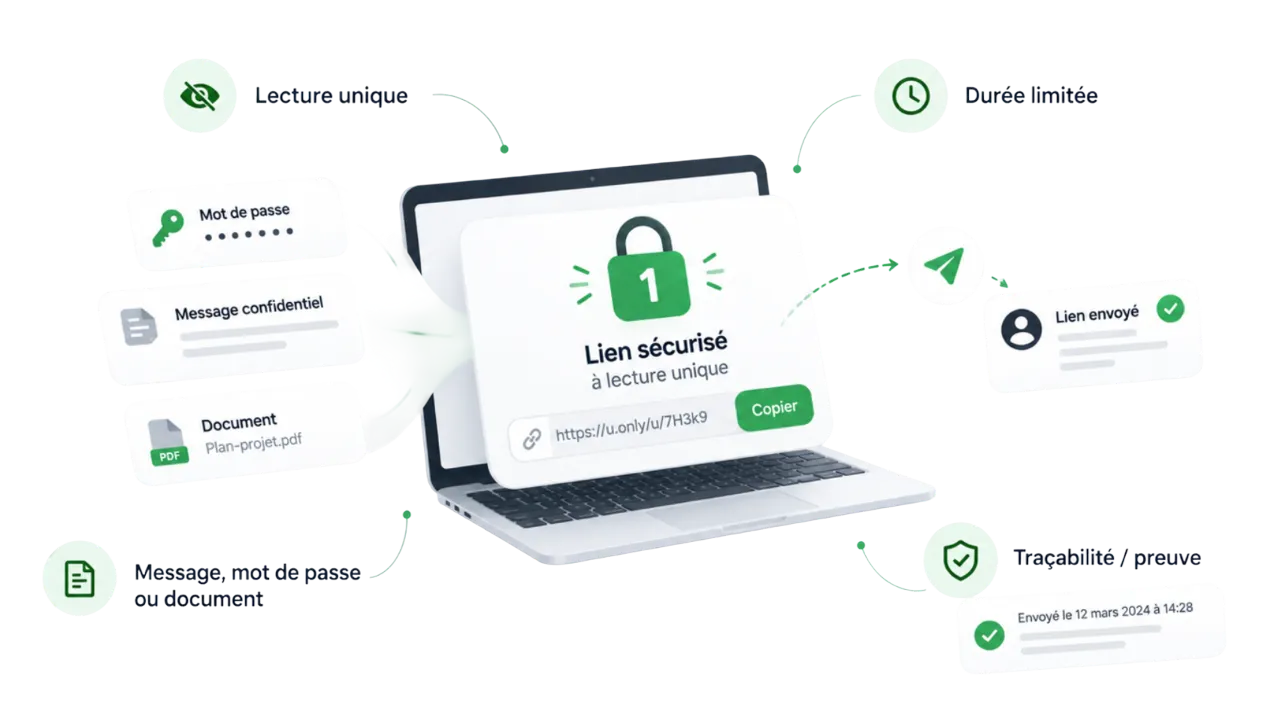
Some information only needs to be viewed once:
A single-use link allows you to share this content without leaving it permanently accessible. Once it has been viewed, access can be made unavailable.
Both mechanisms meet different needs.
Content becomes unavailable after being viewed.
Content remains accessible for a defined period, then expires.
Both can be combined to limit both the number of views and the duration of exposure.
When content contains personal data or sensitive information, its transmission must be adapted to the level of risk. The GDPR notably requires the implementation of appropriate technical and organizational measures to ensure the confidentiality and security of data.
Limiting the duration of access, controlling the number of views, or encrypting content all contribute to this risk reduction approach.
In certain professional contexts, it is not enough to transmit content. It can also be useful to be able to establish:
Civil law recognizes the value of electronic documents, provided in particular that their origin can be established and their integrity is guaranteed (article 1366). Depending on the plan used, OnlyU can add traceability, timestamping, or proof elements to a transmission to document the operation.
A single-use link is particularly suited when content must be shared, viewed, then no longer remain accessible. It allows you to better control: